
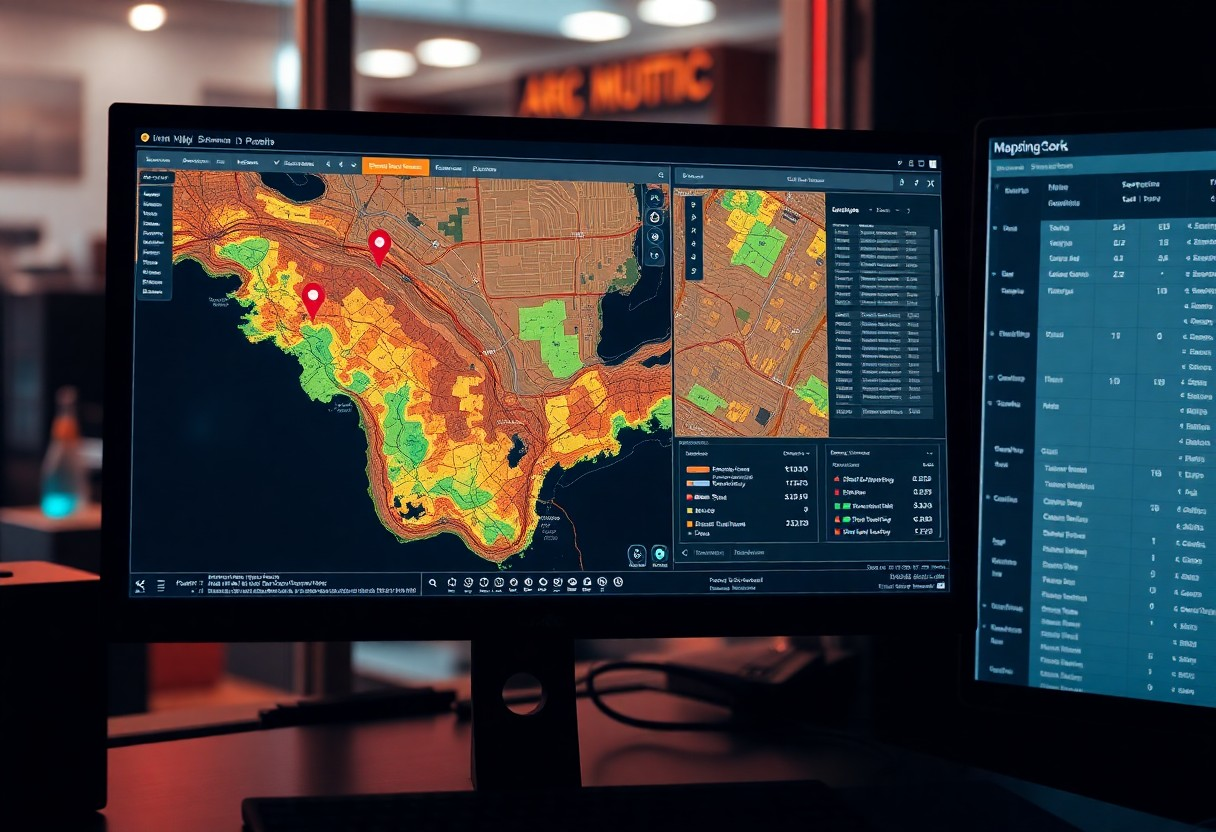
Parcel mapping is imperative for accurately analyzing and comparing land shapes and boundaries. When you need to assess similar polygons, selecting the right coordinates finder can enhance your efficiency and precision. This guide will help you explore the best tools available, enabling you to make informed decisions while ensuring that you achieve accurate results in your mapping endeavors.
The Mechanics of Mapping Similar Polygons
Understanding the mechanics behind mapping similar polygons requires mastering the principles of geometric transformation and scaling. By applying a series of translations, rotations, and dilations, you can effectively recreate similar shapes while maintaining proportionality. Familiarity with geometric properties allows for accurate placement and assessment of polygons in various contexts, whether in urban planning or landscape design.
Coordinate Systems and Their Roles
Coordinate systems serve as the foundation for pinpointing locations in mapping similar polygons. You primarily work with Cartesian coordinates, where points are defined by (x, y) pairs, or polar coordinates, representing points with angles and distances. Choosing the appropriate system depends on your specific mapping needs, influencing how you visualize relationships and transformations between shapes.
Algorithms Used for Polygon Analysis
Algorithms play a vital role in polygon analysis, enabling efficient computations for similarity checks, area calculations, and other geometric properties. Techniques like the Convex Hull algorithm and the Shoelace formula are commonly employed to determine properties and relationships of shapes, allowing for effective and precise mapping.
For example, the Convex Hull algorithm helps identify the smallest convex polygon that encompasses a set of points, making it useful in defining edges of larger shapes. The Shoelace theorem, on the other hand, aids in calculating the area of irregular polygons based on vertex coordinates. Utilizing these algorithms in combination with coordinate systems ensures streamlined processes in mapping, offering you tools for accurate analysis of similarities in polygonal shapes.
Comparing Leading Parcel Coordinates Finder Tools
Analyzing the various parcel coordinates finder tools reveals their distinct strengths and weaknesses. Evaluating features such as data accuracy, mapping capabilities, and pricing can significantly influence your decision. Here’s an overview to guide your choice.
| Tool Name | Key Features |
|---|---|
| Tool A | Real-time data, advanced GIS integration, multi-layer mapping |
| Tool B | User-friendly interface, customizable reports, offline mode |
| Tool C | Robust analytics, bulk data processing, cloud storage |
Feature Set Breakdown
Each tool offers unique functionalities tailored to different user needs. For example, Tool A excels in real-time data accuracy, while Tool B prioritizes usability with an intuitive interface. In contrast, Tool C shines in analytics, providing comprehensive insights into your parcel data.
User Experience and Interface Design
The user experience greatly impacts how efficiently you can navigate mapping tools. Intuitive design elements, such as drag-and-drop features and clear navigation menus, enhance usability. A streamlined layout minimizes confusion, allowing you to focus on mapping rather than troubleshooting. Ensuring a seamless experience can save you time and frustration during critical tasks.
Selecting the Right Tool for Your Needs
Choosing the best parcel coordinates finder hinges on your specific mapping requirements. Consider factors like the complexity of the polygons, the frequency of your needs, and whether you require real-time data integration. Tools vary greatly in functionality, from simple plotting applications to advanced GIS systems, so align your choice with your project’s scale and technical demands.
Assessing Specific Use Cases
Your use case dictates the features you’ll need in a mapping tool. If you’re engaged in urban planning, a solution that offers zoning and land use overlays might be imperative. Alternatively, for environmental studies, look for tools that incorporate ecological data. Identify which functionalities are necessary for your specific type of analysis to optimize your selection.
Cost-Benefit Analysis of Popular Options
Evaluating popular parcel coordinates finders involves weighing both their features and pricing structures. Free tools may suffice for basic tasks but could lack the depth needed for complex projects, whereas premium solutions offer extensive capabilities but at a higher cost. Assessing trial versions or user testimonials can provide insights into effectiveness and value for your specific needs.
For instance, software like ArcGIS provides robust features for comprehensive mapping but comes with a subscription cost that may not suit all budgets. On the other hand, QGIS, an open-source alternative, offers many similar functionalities at no cost, appealing to budget-conscious users. Platforms like MapInfo excel in industry-specific applications but require a significant investment. By carefully analyzing both the tangible benefits of features and the associated costs, you can make a more informed decision that enhances your project’s success while maintaining budgetary constraints.
Real-World Applications of Accurate Mapping
Accurate mapping plays a significant role in various real-world scenarios, enhancing the effectiveness of decision-making processes across multiple sectors. From urban planning to environmental research, tools that provide precise parcel coordinates allow for strategic planning, resource allocation, and overall better management of both land and urban spaces.
Geographic Information Systems (GIS) and Urban Planning
Utilizing Geographic Information Systems (GIS) in urban planning enables you to visualize and analyze spatial data effectively. This technology integrates various data forms, uncovering trends and patterns vital for zoning, infrastructure development, and community services. By leveraging accurate mapping, you can create more resilient and sustainable urban environments.
Environmental Research and Land Management
For environmental research and land management, accurate mapping is invaluable in assessing ecosystems and monitoring land use changes. This approach allows you to manage natural resources sustainably while providing insights into habitat preservation and conservation efforts.
Environmental research heavily relies on precise mapping tools for tasks such as habitat monitoring, resource assessment, and land-use planning. By collecting and analyzing spatial data, you can identify changes in land cover over time, assess the impact of climate change on ecosystems, and improve land management strategies. Advanced mapping helps in pinpointing areas for conservation, leading to more effective resource allocation and environmentally sound practices, ultimately fostering sustainable development goals.
Expert Insights: Navigating the Landscape of Mapping Tools
Leading GIS professionals emphasize the necessity of selecting mapping tools that align with your objectives and data complexity. Many recommend evaluating the user interface and integration capabilities with existing software. Innovations in machine learning are also paving the way for enhanced accuracy in polygon mapping, allowing for more automated workflows and streamlined processes.
Interviews with GIS Professionals
Insights from GIS experts reveal the increasing importance of real-time data integration in mapping tools. Many professionals cite systems like ArcGIS Pro and QGIS as standout options due to their robust analytical capabilities and user-friendly interfaces, emphasizing how these features can significantly improve project efficiency and accuracy.
Predictions for the Future of Mapping Technology
Future mapping technology is anticipated to harness advancements in artificial intelligence and augmented reality, revolutionizing how you visualize and interact with geographic data. Emerging tools are set to integrate real-time satellite imaging and 3D modeling, providing unprecedented detail and insights into spatial relationships, while also enhancing user collaboration capabilities.
As technology evolves, expect enhanced predictive analytics that can identify patterns and trends in environmental changes or urban development. Integration of blockchain for secure data sharing and improved accuracy in real estate transactions is also on the horizon, fostering greater trust and transparency in geographic information systems. With these developments, your mapping experience will become increasingly sophisticated and intuitive, enabling more informed decision-making in land management and planning.
Final Words
On the whole, selecting the best parcel coordinates finder for mapping similar polygons depends on your specific needs, such as accuracy, usability, and features. Evaluate options like Google Earth for its user-friendly interface, or GIS software for more advanced analysis. Using the right tool can enhance your spatial understanding and streamline your mapping projects. Prioritize the functionalities that will best support your work and make informed decisions to improve the efficiency of your mapping endeavors.